Stopping revenue leakage in premium OTT: Why AI-driven content security is the next frontier
Premium content protection backed by forensic accountability
June 30, 2026
Reuven Elmalem


Premium OTT services lose real money to credential sharing, illicit restreaming and live piracy. In inoRain's 2025 industry report, 54% of 300 OTT provider partners lost revenue to piracy.¹ Meanwhile, requirements for UHD, PVOD and forensic traceability keep getting stricter.
Detection alone doesn't fix it. This post makes the case for replacing separate DRM, watermarking and fraud tools with one AI-driven loop that detects, enforces, attributes and acts within minutes.
"Out of 300 OTT provider partners, 54% of providers lost revenue due to piracy"¹
Why do separate DRM, watermarking and fraud tools leave gaps?
Traditional content protection relies on separate tools for DRM, watermarking, and fraud detection. In isolation, these tools create blind spots, slow response times, and can lead to heavy-handed enforcement that hurts the customer experience.

A unified, AI-driven framework connects real-time detection, dynamic enforcement, and forensic attribution so providers can respond faster and more precisely. For example, flagging abnormal concurrent viewing patterns that suggest credential sharing, triggering session-level controls in real time, and preserving attribution data for follow-up investigation.
By combining identity, behavioral signals, and contextual risk analysis, platforms can spot suspicious activity earlier and take proportionate action in real time. This includes abnormal concurrency and rapid device proliferation to unusual playback patterns and emerging restreaming signatures.
How does a closed-loop content security model work?
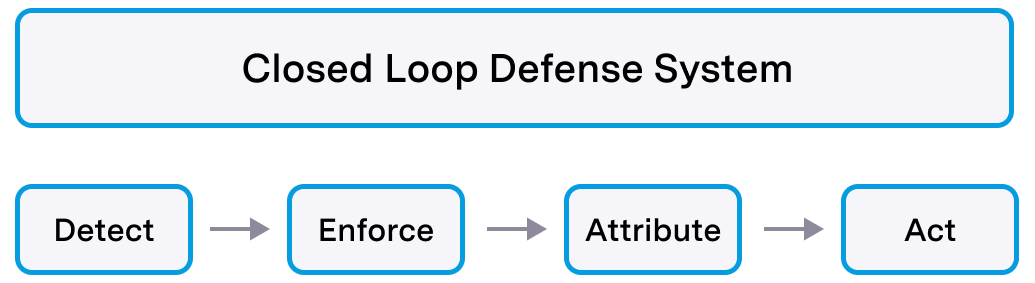
This is where a closed-loop model becomes essential: Detect. Enforce. Attribute. Act. Rather than treating content security as a series of disconnected controls, this approach brings detection, decisioning, enforcement, and proof into a continuous operational cycle designed for premium live and on-demand environments.
1. Detect early with AI-powered risk scoring
AI-powered risk scoring analyzes session metadata, device fingerprints, geo and IP history, and playback behavior to detect anomalies as they emerge.
Because these models adapt as attack patterns evolve, they offer a stronger path forward than static rules or manual review.
2. Enforce intelligently with programmable policies
A modern framework enables tiered responses such as silent monitoring, step-up authentication, conditional stream limits, or targeted session termination—aligning enforcement with business rules, rights obligations, and customer context.
3. Attribute precisely with server-side watermarking
When piracy occurs, server-side forensic watermarking can provide per-viewer traceability at scale—helping operators identify the source of a leak, revoke compromised sessions quickly, and give rights holders stronger proof of compliance.
Because it is server-side, this approach is scalable across platforms and resilient in complex streaming environments.
4. Act in minutes, not hours
The real advantage comes from connecting detection, enforcement, and attribution in a single loop so providers can move from reactive response to proactive control—especially during live events, where every minute of piracy has a cost.
Why does AI-driven content security matter now?
The urgency is growing. Piracy is becoming more automated and sophisticated, while live sports rights, compliance expectations, and margin pressure continue to rise.
AI can detect abnormal viewing and credential-sharing patterns across devices, identify likely restreaming activity during live events, and flag suspicious playback behavior before it turns into broader revenue loss. It can also help correlate signals across DRM, CDN, app telemetry, and account activity so security teams are not forced to investigate each alert in isolation.

Operators that rely on fragmented, reactive systems may find themselves exposed not only to revenue leakage, but to reputational and contractual risk as well. Those that adopt AI-driven, closed-loop security can better protect monetization, customer trust, and premium content value.
"69% of sports fans have turned to illegal streams."²
How is CTS approaching unified revenue protection?
At Comcast Technology Solutions, we see the future of content security as unified, intelligent, and actionable. By combining AI-driven detection, programmable policy enforcement, DRM controls, and forensic watermarking, operators and video service providers can move beyond isolated protections toward a more effective revenue protection strategy.
Detect early. Enforce intelligently. Attribute precisely. Act quickly.
In premium OTT, protecting content is about more than stopping piracy. It is about safeguarding revenue, reinforcing trust with rights holders, and preserving the experience for legitimate subscribers. That is why AI-driven content security is becoming a critical foundation for sustainable growth.
To learn how Comcast Technology Solutions can help you build a more intelligent, end-to-end approach to OTT revenue protection, get in touch with our team.
Frequently asked questions
This Blog contains forward-looking statements regarding future products and features that are currently under development. These statements reflect our current plans and expectations, which are subject to change. We undertake no obligation to update any forward-looking statements to reflect events or circumstances after the date of this Blog.